
Modeling decisions in dynamic context
A language practice room that responds to unfinished speech, different perspectives and a changing learning goal. How do its decisions stay connected?
You can know the words for a disagreement and still lose your place in the conversation. Someone takes your conditional answer as a promise. Another person asks a different question before you finish. You need to recover the condition, answer the new question and keep the discussion moving.
A language practice app could let you work on that exact difficulty. Keep the subject. Keep the people and their different concerns. Change how much help they give you, or what one person understands. Then continue speaking in your own words.
This article designs that instrument: a conversation whose demands you can shape while it continues. The learner controls the kind of practice. The software coordinates the situation around their spontaneous speech. A fixed list of dialogue steps cannot specify all its useful continuations.
The design needs several kinds of learned judgment. What did the learner mean? Who heard which part? What has the group actually agreed? Which response gives the learner room to practice? How should that response change when the learner interrupts?
We will follow one complete encounter, then work backward through the model tasks and tools it requires. The interface and film below illustrate a proposed product. They contain authored examples, not recorded model inference or measured learning results.
Shape the conversation you need to practice
Keep the subject. Change the demand. Continue in your own words.
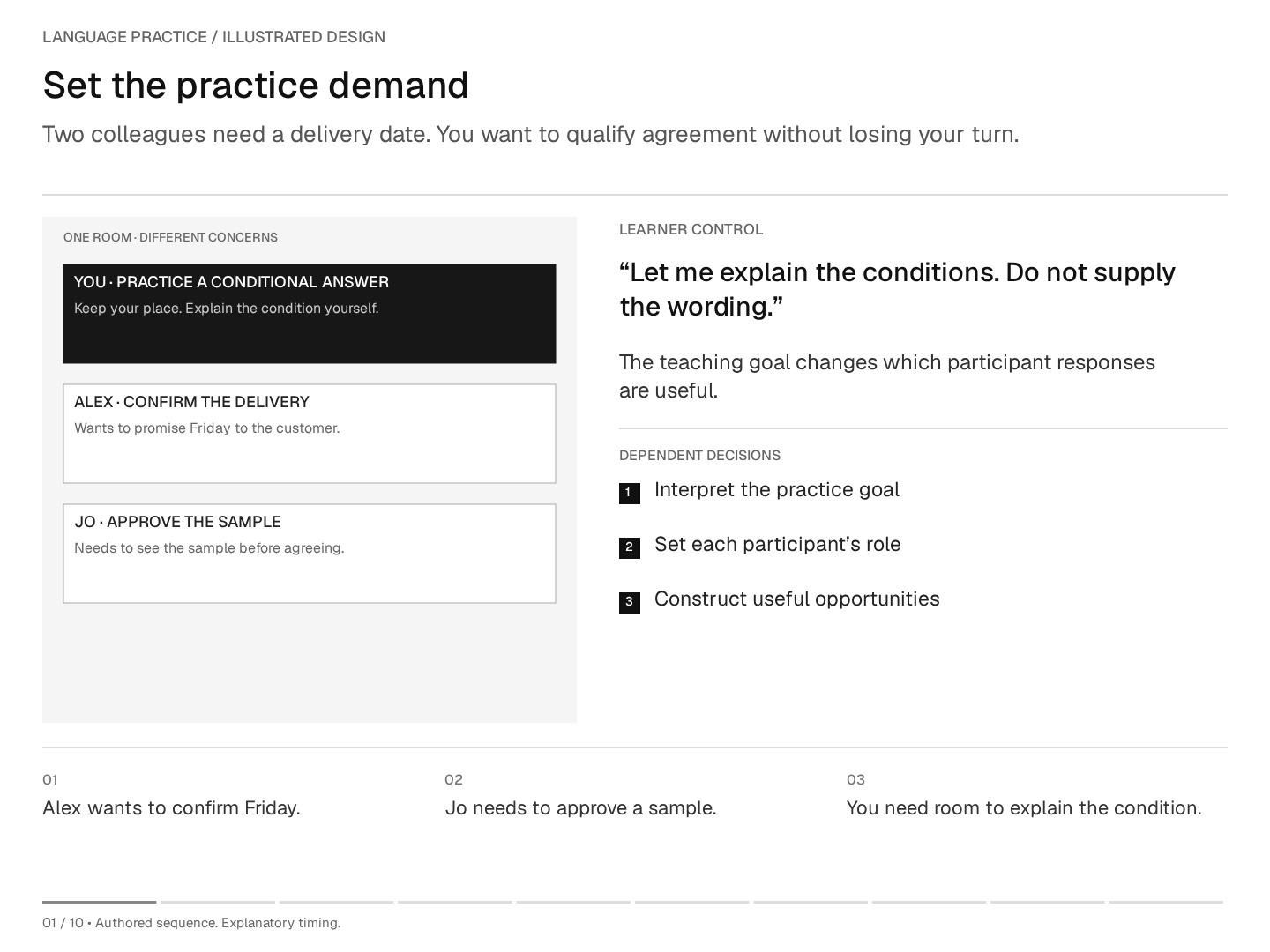
Set the practice demand
Two colleagues need a delivery date. You want to qualify agreement without losing your turn.
Learner controlLet me explain the conditions. Do not supply the wording.
The teaching goal changes which participant responses are useful.
- Interpret the practice goal
- Set each participant’s role
- Construct useful opportunities
Alex wants to confirm Friday.
Jo needs to approve a sample.
You need room to explain the condition.
Watch the annotated sequence · 2:00 · silent
Let the learner change the situation, not just the prompt
The learner joins two simulated colleagues. They must choose a delivery date for a customer presentation. Alex wants to confirm Friday. Jo needs a sample before committing to that date. The learner wants practice in qualifying agreement and repairing a misunderstanding without abandoning the discussion.
The room has three controls with consequences inside the conversation:
- Choose the demand. “Make me explain a condition without giving me the wording.”
- Change one perspective. Let a participant hear, miss or misunderstand a particular part of the discussion.
- Return to a moment. Try another continuation from the same situation, with a different degree of support.
These controls specify relationships, rather than prescribed replies. The software must recognize a valid repair across many phrasings. It must also distinguish a learner’s own explanation from an answer that a helpful participant supplied for them.
The learner begins:
Friday could work, if…
A pause follows. The app has two unfinished questions. Has the learner finished speaking? And what condition are they about to add? An audio model can inform the first question. The words suggest that the second remains open. The simulated colleagues leave room for the learner to continue.
…we send the sample first. I need Jo to approve it before we promise the date.
The discussion now contains a proposal with a dependency. Friday depends on sample approval. It does not contain an unconditional promise to deliver on Friday.
Alex starts to respond:
Good, then I’ll confirm Friday with the customer—
The learner interrupts:
Wait. We can confirm it after Jo approves the sample. I’m saying Friday is possible, not agreed.
The response must affect more than a transcript label. Alex stops speaking. The group still has Friday as a candidate date. Sample approval remains unresolved. Jo has a useful reason to speak next: the group needs to know when that approval can happen.
The practice opportunity also changes. The learner has made an explicit repair. The software should not immediately repeat the same misunderstanding as if nothing happened. It can let the repair work, then create a different opportunity to use the distinction.
One sentence can belong to several contexts
Jo asks:
Can you send the sample on Tuesday?
The learner replies:
After the client signs off on the dimensions.
That answer can be meaningful without naming Tuesday. The system must connect it to the sample question and retain a new dependency: sending the sample depends on the client’s approval. It must not replace the earlier dependency between sample approval and the Friday commitment.
There are now two conditions in a chain. The distinction matters when Alex says:
The client has approved the dimensions. So can I confirm Friday?
A useful continuation tests whether the learner can identify what has changed and what has not. The first condition is satisfied. Jo still has to approve the sample. A participant who explains the whole chain for the learner would remove the intended practice.
The learner can say:
That lets us send the sample. We still need Jo’s approval before we confirm Friday.
A grammar checker can assess the sentence. A conversation model must assess its effect on the shared plan. A teaching model must assess whether it supplies evidence of the skill being practiced. Those are different questions about the same event.
The app should retain uncertainty when the reply is ambiguous. “Then we’re ready” might refer to sending the sample or confirming the delivery. A short question from Alex can resolve the reference. The system should not silently choose the interpretation that makes the exercise appear successful.
Give each participant a different view
The learner now changes the exercise:
Let Alex miss the part about Jo’s approval. I want to practice bringing him back into the discussion.
The software introduces a brief absence at the selected point. Alex returns knowing that the dimensions are approved, but without hearing the later condition. Jo retains the complete exchange. The learner sees this change as a visible event in the room.
Alex’s next question should follow from that limited view. Jo’s response should follow from hers. Neither participant should inherit the application’s complete record merely because it sits in one large context window.
This creates a useful division of knowledge:
| View | What it must contain |
|---|---|
| The room | Actual events, who was present, and which words were played. |
| Alex | His instructions, heard events and current interpretation of the plan. |
| Jo | Her instructions, heard events and current interpretation of the plan. |
| The teaching policy | The chosen practice demand and evidence from the learner’s attempts. |
| The learner | The conversation and visible controls, without a compulsory technical dashboard. |
Exact code can record that Alex was absent. A learned judgment is needed to interpret what his remaining evidence supports. “Not heard” differs from “heard but misunderstood.” Both differ from “understood but disagrees.” The interface should let the learner choose the kind of challenge without treating those states as interchangeable.
The participants are constructed roles. Their beliefs do not diagnose the psychology of real people. The point is to make a conversational difficulty controllable and repeatable inside a practice tool.
Build decisions around the relations that can change
The useful unit of work is often a relation between an utterance and something already active. Does this reply answer Jo’s question? Does it accept Friday, qualify Friday, or leave that proposal unresolved? Does it repair Alex’s misunderstanding?
A task can receive one candidate relation with its relevant context. A small set of defined outcomes makes that judgment available to the rest of the application. Many candidates can be assessed at once.
For the interrupted exchange, the architecture could use these tasks:
| Layer | Candidate being assessed | Context that changes the answer |
|---|---|---|
| Turn control | Continue listening, take a turn, or yield | Audio, overlap, recent speech and incomplete phrasing |
| Meaning | A phrase qualifies a proposal, answers a question, or repairs an interpretation | Candidate reference, nearby utterances and the speaker’s current turn |
| Shared plan | A proposed change to a commitment or dependency | Accepted events, unresolved conditions and existing alternatives |
| Participant perspective | A possible interpretation by Alex or Jo | Only that participant’s available evidence and instructions |
| Practice opportunity | A possible demonstration of the chosen skill | The demand, prior help and what the learner actually supplied |
| Participant action | Ask, clarify, challenge, acknowledge, or leave space | Perspective, shared plan, practice opportunity and current floor |
| Group coordination | A complete set of compatible participant actions | Local assessments, turn ownership and actions already underway |
These rows do not require seven separate models. Related tasks may share weights or inference. They do require distinct contracts. Otherwise, a high score for grammatical correctness can accidentally stand in for successful repair.
Consider six candidate relations for a new phrase. Their first assessments can proceed in parallel. A commitment update then depends on the relevant relation results. Alex and Jo can each develop candidate responses from their own views. A group decision chooses a compatible continuation after those candidates exist.
Parallel work reduces avoidable waiting. Dependencies preserve meaning. The system cannot decide which clarification is useful before it knows what remains ambiguous.
Continue to interpret while speech is underway
The software should not wait for a complete transcript before doing any semantic work. It can begin with a tentative interpretation, revise it as words arrive, and distinguish a possible response from words already spoken.
Schlangen and Skantze’s incremental dialogue framework represents small units of processing with dependencies, revisions and commitments. Its worked systems connect interpretation to speech planning and track which speech has already occurred. That provides a foundation for this design. It does not establish the proposed learning experience. A General, Abstract Model of Incremental Dialogue Processing, Sections 3–4
There are three different moments in Alex’s response:
- The system considers an act: treat Friday as agreed.
- A generator prepares words that realize that act.
- The audio tool plays some of those words to the learner.
An interruption can cancel an unplayed continuation. It cannot remove a claim that the learner already heard. If the spoken part created a misunderstanding, the next act may need to acknowledge and repair it.
That distinction connects several layers. Audio playback reports the actual heard prefix. The discourse layer updates the conversation. The practice layer assesses the learner’s repair. The participant layer chooses how to respond. A cancelled output string alone would lose the conversational effect.
Turn-taking also requires audio evidence. Ekstedt and Skantze studied models that predict future voice activity from two-speaker audio. Their prosody experiments show why lexical information alone can miss whether a speaker will continue. That work does not establish a multi-party teaching policy or a language-learning result. How Much Does Prosody Help Turn-taking?, Sections 5–7
A text decision model can work with recognized words and defined context. It does not replace speech recognition, acoustic turn prediction or speech synthesis. These components need their own evaluation and integration.
Two loops, with different deadlines
An interruption needs a fast audio response. A useful next conversational move can require more semantic work. Those operations should not share one blocking queue.
The audio loop detects speech activity, handles overlap and controls playback. It can stop the current output without waiting for the teaching layer to explain why the learner interrupted.
The meaning loop develops interpretations, updates the active plan and selects possible participant acts. It can prepare a continuation while listening remains active. Before speech begins, the coordinator checks that the act still fits the current floor and discussion.
The teaching goal changes more slowly. It can persist across many turns while its opportunities change with each event. This gives the architecture several useful timescales instead of one universal refresh rate.
A deployment must measure the complete path to each visible effect. Fast model scoring inside a worker does not establish fast speech response over a hosted API. The current service evidence does not qualify this conversational loop. Its audio path and semantic path would need separate latency budgets, including queueing, recognition, generation and playback.
Useful failure behavior follows from those deadlines. If a semantic decision is late, a participant can remain silent. It should not interrupt with an obsolete clarification after the learner has already resolved the issue.
Make the practice goal an active part of context
Suppose the learner changes the goal:
Same situation. Less help. Make me explain why the remaining approval matters.
The shared facts do not change. Jo still needs the sample. Alex still wants to confirm the date. What changes is the value of different participant actions.
Jo could explain the condition for the learner. That would be coherent conversation, but poor practice under the new request. Alex could ask, “What could go wrong if I confirm it now?” That leaves the explanation to the learner while remaining natural in the scene.
The action assessor therefore needs two distinct judgments: whether an act fits the conversation, and whether it serves the chosen practice demand. A fluent reply can pass the first and fail the second.
Published tutoring work already separates dialogue generation from auxiliary instruction and progress tasks. TUTORING uses an instruction-grounded dataset and tasks that track progress through its instruction sequence. This is a useful precedent for task-specific training. It does not test the branching, participant-specific encounter proposed here. Chae and colleagues, TUTORING: Instruction-Grounded Conversational Agent for Language Learners
The proposed product needs a further distinction: an opportunity can remain unresolved because the learner did not have room to respond. That differs from an unsuccessful attempt. A simulated colleague who answers every question can make the session look fluent while producing little useful practice.
Return to the difficulty without prescribing the answer
The learner selects Alex’s premature confirmation and chooses Try this moment again.
The tool restores the shared facts, each participant’s heard history, the current speech state and the practice goal. It starts a new continuation. It does not replay the old participants’ future answers unchanged, because those answers must now respond to the learner’s new words.
A comparison can show the actual effect:
| First attempt | Second attempt |
|---|---|
| The learner leaves the condition implicit. | The learner names the remaining approval. |
| Alex asks which part is still uncertain. | Alex asks when Jo can decide. |
| The learner receives a hint before repairing the plan. | The learner repairs it without that hint. |
This table describes an authored example, not a measured learner outcome. In a product, each row must link to actual heard speech. The model should allow more than one valid way to repair the plan.
Later, the app can introduce a new condition in a different part of the discussion. Does the learner preserve it without a prompt? That supplies different evidence from succeeding immediately after a hint. Neither observation alone establishes lasting learning outside the app.
The new interface makes a difficult moment available for deliberate work. The learner can retain the situation, change the demand, vary another participant’s perspective and try again. The architecture keeps those controls meaningful throughout the exchange.
Train on changes that should change the answer
Paraphrases are useful, but they are not enough. The training set needs pairs where similar words have different effects because the active context differs.
- “That works” accepts a date when the current question concerns the date. It may accept a sample procedure when that is the active question.
- “Before Friday” qualifies the delivery in one exchange and the approval deadline in another.
- A participant’s clarifying question can support a beginner and provide an unwanted hint in a less-supported attempt.
- An unfinished condition can retain the learner’s turn. A completed sentence with the same last word may permit a response.
- A remembered fact can belong to the room but remain unavailable to a participant who missed it.
Construct examples through the actual tools. Retain the source conversation, audible output boundaries, participant views and practice goal. Review the semantic targets independently from the generator’s intended answer.
A downstream model must also see upstream mistakes. Include an incorrect reference, a missed condition and a falsely inferred agreement. Test whether the next layer can ask for clarification, preserve alternatives or decline to act.
Split whole source conversations and their branches together. A near-identical replay in the test set would overstate generalization. Hold out situations, paraphrase families and patterns of interruption, rather than testing only unseen rows from the same encounter.
Evaluate the whole encounter
Compare several designs with the same speech components and practice situations: a scripted dialogue, a general model with the same tools, and the proposed division into learned tasks. A more elaborate architecture must improve the experience enough to justify its cost.
Measure consequential errors: a false commitment, an unearned hint, a participant using information they never heard, a repair ignored, or a late response that interrupts the wrong turn. Measure complete response delays and the frequency of silence or clarification as well.
Human review must assess whether the interaction remains a plausible conversation and whether the controls create the intended practice. Learning claims need a separate study with appropriate outcomes. A classifier score cannot supply them.
Dynamic context includes the developing meaning, each participant’s view, the learner’s chosen demand and the action already underway. Modeling these relations makes them available to software. The result could let a person shape a conversation at the level of the difficulty they want to work on, while the conversation remains alive.